Showing posts with label SOCIAL NETWORKING. Show all posts

Wednesday, November 24, 2010

Open Source social network, Diaspora, begins private alpha

Diaspora is the brainchild of four NYU students looking to create a Facebook alternative that places privacy at the forefront of its mission. Today they announced the software is entering into private alpha by invite only.


Diaspora is an open-source project that is using Ruby on Rails to build a social network that focuses on user privacy. As announced today on its blog, Diaspora will begin sending out invites for users to test their private alpha, starting with Kickstarter backers and then those on its email list.
“We are proud of where Diaspora is right now. In less than five months, we’ve gone from nothing to a great starting point from which the community can keep working. We’ve spent a lot of time thinking about how people can share in a private way, and still do all the things people love to do on social networks. We hope you’ll find it fun to use and a great way to keep in touch with all the people in your life.”


Diaspora is designed to help you decide which information to share with whom and has created the notion of “aspects” to help users separate out friend lists and corresponding levels of profile openness or privacy. The group explains:


“Diaspora lets you create “aspects,” which are personal lists that let you group people according to the roles they play in your life. We think that aspects are a simple, straightforward, lightweight way to make it really clear who is receiving your posts and who you are receiving posts from. It isn’t perfect, but the best way to improve is to get it into your hands and listen closely to your response.”


The team has a long way to go and several more features to implement before making Diaspora publicly available. If you would like to help Diaspora get off the ground, you can find more information on their website.

Friday, October 15, 2010

Facebook Or Online ‘friend’ may be a federal agent

A new report unveils that the government has been briefly monitoring social networking sites, Facebook, MySpace , Orkut and Twitter.

It’s clever to watch what you say, and cleverer to watch what you say online, because you never know who might read it. In answer to a Freedom of Information request (FOIA), the government released documents unveiling that social networking sites are being deeply monitored. According to the report by the Electronic Frontier Foundation, social sites like Facebook, MySpace, Twitter, and Flickr were targeted, as well as Wikipedia, Craigslist, many political commentary sites, and NPR, among others.

One document reveals widespread information collecting around the time of the 2009 inauguration of President Obama: “Narcissistic tendencies in many people fuel a need to have a large group of ‘friends’ link to their pages, and many of these people accept cyber-friends that they don’t even know. This provides an excellent vantage point for FDNS to observe the daily life of beneficiaries and petitioners who are suspected of fake activities.”

While some use of social media to monitor fraud and security can be defensible, the EFF is worries that such extensive monitoring could turn a harmless, offhand status update into a blown out investigation.

“While there have been some reports in the past year of similar social network monitoring for large-scale public events,” said the EFF, “to date the public has not seen such detailed information about the government’s approach to monitoring, especially on its data protection practices. As our FOIA lawsuit continues, we hope to learn more about such activities and help bring further transparency and accountability to the ways in which government agencies and law implementation officials collect and analyze information about us online.”

Are you worried about the government stretching its authority and over-monitoring tweets and updates? Or is this a good thing, as it could potentially help deal with or prevent a disaster?

Thursday, October 14, 2010

Skype 5 dials up Facebook integration

Skype 5 for Windows is out of beta, allowing Facebook users to post status updates, comments, and like items from directly within Skype. 

Leading VoIP service Skype has officially launched Skype 5 for Windows, which makes the real-time chatting application more social than ever by integrating with Facebook. Skype users will be able to act together with Facebook friends and communities right within the Skype application, posting status updates and comments, liking items, and  call & SMS their Facebook friends.

Skype 5 integrates a news feed of status messages from Facebook friends who are using Skype, and enables users to set their own Facebook status using a feature called “mood messages.” The services rely on users linking their Facebook account to their Skype account; at that point, any friend who has made their phone number available on Facebook can be called directly from Skype.

In addition to new social features, Skype 5 also aims to further expose some long-standing but not-as-widely-used features of the service via a Skype Home tab, including screen sharing, SMS, file sharing, and more. A new search feature automatically shifts friends to the top of results listings, and Skype says the new version of the applicationoffers improved call quality and is less likely to drop calls

Skype is also expanding its group video calling service, enabling support for up to 10 participants in a single video chat although the group video calling feature is still in beta, and Skype envisions eventually charging for it separately as an add-on service. Skype has claimed that more than one third of the calls it currently handles are now video calls and anticipates video calls will eventually become the norm.

The Skype client application remains free, and Skype-to-Skype calling remains free; however, users must pay to connect to mobile phones and traditional landline phones, albeit at rates that are usually substantially lower than traditional phone carriers. Skype says a version of Skype 5 for Mac OS X will be available soon.

Tuesday, October 5, 2010

Facebook and Skype will Collaborate

Facebook and Skype will be announcing a partnership that will see Skype collaborate with Facebook.


This service would bring a whole new dimension to interacting with friends on Facebook, allowing for voice calls, SMS(short Message service) and  video calls too.

This could be a major win for Facebook, which has a limited chat function that, up to now, has been unable to compete with other chat services, such as GTalk, yahoo. Skype has over 500 million registered users with over 124 million using the service once a month. Add to that the 500 million users Facebook has and the cross flow of users could help both companies boost their bases and popularity.

The new features should go live on Skype 5.0 which is coming out of beta in a couple weeks.

Thursday, August 26, 2010

Facebook Ends IE6 Support, and You Should Too


Facebook is ending support for Internet Explorer 6. Granted, it is only pulling the plug on IE6 in its chat function, but the move by Facebook is the latest effort to shift away from the outdated browser that refuses to die. Facebook's decision illustrates once again why organizations that still rely on IE6 should consider upgrading (finally).
A Facebook Blog post describes the issue behind the decision: "Many of you have told us that sometimes your Chat session comes and goes or even stops completely. We're working hard to end those interruptions so that your experience is stable and consistent."
The blog post goes on to explain, "The biggest improvements come from changes that aren't supported on older Web browsers. After evaluating the alternatives, we've decided to make rapid improvements and provide the best Chat experience possible, which means we will no longer support Internet Explorer 6 browsers."
I don't expect that compatibility with Facebook Chat will be a compelling reason for IT admins to follow suit and drop the venerable Web browser, but the underlying reasons behind the Facebook decision are worth exploration. The bottom line is that many of the Web technologies used today are simply not supported on a browser that was created almost a decade ago and is two--going on three--generations out of date.
Internet Explorer 8 has only been available about 18 months, and it has already emerged as the number one browser in the world in terms of market share. Not only is it the leading browser, but its rate of growth continues to outpace competing browsers as well. Sadly, Internet Explorer 6 remains as the number two browser, but thankfully it is in decline.
For many IT admins, the inability to use cool new bells and whistles on the Web is also not a very compelling argument for change. In fact, it might be a justification for keeping IE6.
The primary concern with IE6, though, isn't compatibility with Web 2.0--it's security on an increasingly insecure Web where attackers have determined that the browser is often the weakest link and the easiest point of entry into the network. Internet Explorer 6 was designed a decade ago, and it was designed to protect against decade-old security concerns.
IE6 is missing key security controls like DEP (Data Execution Prevention) and PMIE (Protected Mode IE) that make it more difficult for attackers to exploit memory corruption vulnerabilities, and limit what an attacker can access or exploit even if they gain control of the IE process.
Microsoft is getting ready to launch the public beta of the next-generation browser--Internet Explorer 9--on the same day that Facebook will officially end support for IE6 in its chat function. It seems like the perfect time to re-examine the pros and cons of staying on IE6 and seriously consider upgrading to a more current browser.

Wednesday, August 25, 2010

Should parents 'friend' their kids?


To friend or not to friend is the big question facing many parents dealing with teenagers on Facebook.
Three quarters of parents questioned in a Nielsen survey said they are friends with their children on the popular social networking website which boasts 500 million active users. But a third admitted they are worried they are not seeing everything their children are doing on the web.
Perhaps with good reason, as nearly 30 percent of teens said if given the choice they would unfriend their parents.
"The No. 1 parenting issue, as least with my discussion with parents, is living on Facebook," said Regina Lewis, a consumer adviser with online services company AOL, which jointly developed the survey.
"It is part of the modern-day parenting reality."
The average number of friends on Facebook is 130 but for teenagers it can be much higher, according to Lewis.
"I thought the percentage of parents who were friends with their kids was strikingly high. It is more than 70 percent," she said, adding that children were twice as likely to want to unfriend their mother than their father.
For some children friending a parent is not always an option. In 41 percent of households there was a rule that children who use Facebook have to be friends with their parents.
"For some parents that became a non-starter," said Lewis.
The friending issue is a delicate balancing act between children thriving for more independence and their parents' desire to see what is going on to make sure their children are safe.
In nearly half of cases, children said they would prefer to be friends with their parents privately on the web without their parents having the ability to post comments.
Nielsen questioned 1,024 parents and 500 children aged 13 to 17 for the online poll. More than half of the youngsters admitted they do not personally know all of their Facebook friends, and 41 percent of parents said they knew half or less of their children's Facebook friends.
"Friending friends is certainly a way to populate your list quickly," said Lewis.
"That is why the number of mutual friends is one of those really important factors in figuring out who may be a outlier," she added, referring to someone who shouldn't be there.
Twenty percent of parents admitted they had told their children to unfriend someone.
Whether they are friends or not, Lewis said that to be responsible parents need to keep an eye on what their children are doing online.

Facebook overtakes Orkut in India: comScore


New Delhi: Internet giant Google's social networking platform Orkut has lost yet another turf to the surge of Facebook.
India, one of the few countries where Orkut retained the top spot amongst social networking websites, now has more people logging on to Facebook, says marketing research company comScore.
According to comScore, Facebook grabbed the number one ranking in the social networking category for the first time in July with 20.9 million visitors, up 179 per cent versus year ago. Orkut registered a growth of only 16 per cent in the same time period.
"The social networking phenomenon continues to gain steam worldwide, and India represents one of the fastest growing markets at the moment," says Will Hodgman, comScore executive vice president for the Asia-Pacific region. "Though Facebook has tripled its audience in the past year to pace the growth for the category, several other social networking sites have posted their own sizeable gains."
In July 2010, more than 33 million Internet users aged 15 and above visited social networking sites in India, representing 84 per cent of the total Internet audience. While India's total Internet audience grew 13 per cent, social networking usage rose 43 per cent.
This makes India the world's seventh largest market for social networking. Only US, China, Germany, Russian Federation, Brazil and the UK rank above India.
Amongst the top social networking sites, Twitter had the most impressive growth with 239 per cent increase in the number of visitors since July 2009.


Thursday, August 12, 2010

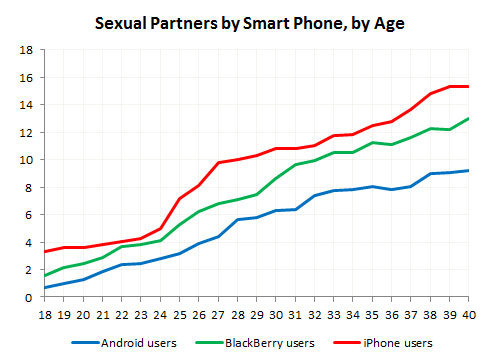
Dating site claims "iPhone users have more sex" than other smartphone users


OkCupid, an American dating site, claims to have statistical information that shows iPhone users have twice as much sex as Android users. It claims this after correlating information from over half a million profile images uploaded on the site, and the 11.4 million responses generated by them. Confused as to the link between a particular smartphone’s user’s sex life and the camera used to take the user’s profile picture? Join the club, and make insightful remarks about correlation not being synonymous with causation, in the below comments section.
Instead of focussing on the context of the profile photo, OkCupid has used flash, focus, aperture, and time of day as parameters of measurement. Here are the steps of their ‘experiment’, paraphrased by us:
1. Collected 552,000 example user pictures.

2. Paired them up (randomly?) and asked users to make snap judgments, like so:3. Collated millions of judgments with EXIF data of the photograph, including flash, focus, aperture, and time of day
4. Made rather uncontrolled statistical statements, without ensuring other variables remain the same, or if causation is actually equal to correlation in this case.
These are their findings:

Panasonic > Canon > Nikon

(type and brand of camera you use have an effect on how attractive you look)
Okay, so as OkCupid claims is evident by the graph, better cameras make you look better! Or maybe, if you are better looking you sailed through life with a smile and so could afford a better camera? Or if you are better looking, you are able to snag a partner with enough money to buy a better camera? Seem absolutely ludicrous? That’s the problem with such stats. They don’t prove anything except the ingenuity of the human mind. Using three pictures of one user taken by three different classes does NOT eliminate all other variables. EXIF data, the entire basis of their statistical avalanche, is by itself considered error-ridden!
How did OkCupid hit upon this amazing statistic? Let’s just see shall we? Using the same age group for the data of all three major phone brands, of 30 years, OkCupid used the above photo- attractiveness data, and then “crossed all kinds of user behaviours with the camera models, and found [they] had data on the number of sexual partners for 9,785 people with smartphones. We dropped what we found into Excel, and voila.” Yes, that explanation really helps us understand how the site went from photo-attractiveness of the profile images clicked by each camera phone to the number of sexual partners per smartphone user. In fact, if one looks at the photo-attractiveness by camera brand and class graph again, we see that amongst the three major smartphone brands, BlackBerry phones take the least attractive photos, iPhones take the most attractive, while Android phones fall somewhere in between. The number of sexual partners per smartphone user graph however (above), shows Android below BlackBerry in numbers. Puzzling, and again begging the question: exactly what other data they used to collate the results?
Perhaps the most telling mistake about the post and the statistics is: even if we accept iPhone users have more sexual partners than Android or BlackBerry users, this does not mean they have “more sex”. Without being overly elaborate and risk offending our more sensitive readers, we can safely say promiscuity is not directly related to frequency. In fact, the title of the post, the wording of the inference, and even the axes of the graph, are misnamed: ‘Sexual Activity’ is once again not directly proportional to ‘avg. number of sexual partners’. Yes, even if you ARE aged 30.
The rest of the post was more information correlating different camera parameters and the photo- attractiveness, from time of day to flash and aperture range. The post ends by advising you to buy a better camera, take pictures in soft light - pictures which focus on you more than the background - without flash, preferably in the afternoon (though if the charts are anything to go by, then take pictures at either 6AM or 5PM), and then post those as your profile pictures. And then, inexplicably but predictably, it asks you to go buy an iPhone.
Apparently OkCupid has a daughter site called OkTrends, which compiles such data regularly, and presumably ( if the above claim is anything to go by) every so often announces some rather arousing inferences. Maybe they should stick to making dates, not data. You say the world doesn’t need another statistician? We ask - just how many is too many?

Tuesday, June 22, 2010

Twitter a Hit in Japan as Millions 'Mumble'

Japan has embraced Twitter in a big way, and analysts say the arrival of the Japanese language Twitter service in 2008 tapped into a greater sense of individuality in Japan, especially among younger people less accepting of the understatement and conformity their culture is usually associated with. Some liken Twitter use to creating haikus.
Twitter is a hit in Japan, succeeding where other social networking Relevant Products/Services imports like Facebook have foundered as millions "mumble" -- the translation of tweet -- and give mini-blogging a distinctly Japanese flavor.

The arrival of the Japanese language Twitter service Relevant Products/Services in 2008 tapped into a greater sense of individuality in Japan, especially among younger people less accepting of the understatement and conformity their culture is usually associated with, analysts say.

A mobile Relevant Products/Services version of Twitter started last October, further fueling the Twitter boom in a nation where Internet-connecting cell phones have been the rule for years.

These days, seminars teaching the tricks of the tweet, as the micro-blog postings are known, are popping up. Ending Japanese sentences with "nah-woo" -- an adaptation of "now" in English -- is hip, showing off the speaker's versatility in pseudo-English Twitter-speak.

A TV show features characters that tweet. A Tokyo bar has screens showing tweets along with World Cup games. And pop idols, a former prime minister and plain regular people are all tweeting like crazy.

The proportion of Japanese Internet users who tweet is 16.3 percent and now surpasses the ratio among Americans at 9.8 percent. Twitter and Japan's top social networking site, mixi, have been running neck-and-neck with monthly visitors between 9 million and 10 million but in April Twitter squeaked past mixi, according to ratings agency Nielsen Online.

In contrast, only 3 percent of Japanese Internet users are on Facebook compared with 62 percent in the U.S., according to Nielsen. MySpace has also failed to take off in Japan, at under 3 percent of Net users versus 35 percent in the U.S., according to comScore Inc.

Twitter estimates Japanese write nearly 8 million tweets a day, or about 12 percent of the global Relevant Products/Services total. Data from Tweet Sentiments, a web site that analyzes tweets, show Japanese are sometimes tweeting more frequently than Americans.

"Japan is enjoying the richest and most varied form of Twitter usage as a communication tool," says Daisuke Tsuda, 36, a writer with more than 65,000 "followers" for his tweets. "It's playing out as a rediscovery of the Internet."

One reason is language. It's possible to say so much more in Japanese within Twitter's 140 letter limit. The word "information" requires just two letters in Japanese. That allows academics and politicians to relay complex views, according to Tsuda, who believes Twitter could easily attract 20 million people in Japan soon. 

Another is that people are owning up to their identities on Twitter. Anonymity tended to be the rule on popular Japanese Web sites, and horror stories abounded about people getting targeted in smear-campaigns that were launched under the shroud of anonymity.

In contrast, Twitter anecdotes are heartwarming. One well-known case is a woman who posted on Twitter the photo of a park her father sent in an e-mail attachment before he died. Twitter was immediately abuzz with people comparing parks.

So far, people are flocking to Twitter in positive ways, reaching out in direct, public and interactive communication, debunking the stereotype of Japanese as shy and insular, says Noriyuki Ikeda, chief executive of Tribal Media House, which consults on social media marketing.

"Twitter is turning out to be like a cocktail party," he told The Associated Press. "Japanese see how fun it is to network Relevant Products/Services and casually connect with other people."

Twitter is also proving a good business tool. Companies are exploring Twitter as a way to reach consumers and get feedback, a function that holds potential in Japan where broadband connections are widespread and cheap, and mobile phones outnumber the population.

Retailer Tokyu Hands uses Twitter to answer queries from customers, while clothing-chain Uniqlo has used Twitter in marketing by setting up a virtual queue where people tweet with each other and get freebies.

Motohiko Tokuriki, chief executive of consultant Agile Media Network, who has nearly 200,000 followers, believes Twitter is on its way to be chosen the hit new word of the year, a coveted honor that draws great publicity here.

"It's telling that Twitter was translated as 'mumbling' in Japanese," he said. "They love the idea of talking to themselves," he said.

Twitter may even offer Japan's web entrepreneurs global opportunities that had so far eluded them because it's the first digital "global-standard" outside of search engines like Google or Yahoo! to catch on here, says Toru Saito, chief executive of Loops Communications, which specializes in social networking businesses.

That means software applications Japanese develop for Twitter could win acceptance from a global market. Japanese mobile software products have tended to be for Japanese up to now.

"I'm getting so many queries, including those from abroad," Saito said.

Rocky Eda, corporate communications Relevant Products/Services manager for Digital Garage, which supports Twitter's Japan operations, is thrilled people are embracing Twitter.

"In finding fulfillment in expressing what's on your mind for the moment, Twitter is like haiku," he said. "It is so Japanese."