Showing posts with label SSD. Show all posts
Friday, December 10, 2010
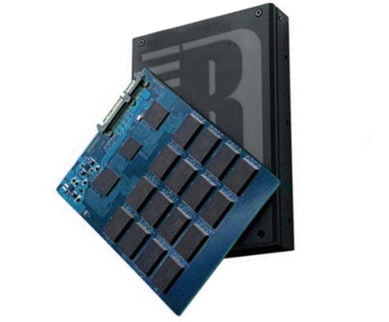
RunCore's unveiled 1TB SATA III SSD is 3.5-inches and 1TB big, 500MB/s fast
An average SSD fits in a laptop 2.5-inch size slot and does so humbly. RunCore's next SSD powerhouse, however, is a little more bodacious. It takes up a desktop standard 3.5-inch slot and is said to rely on "large" sized PCBs on both sides of its cool, cerulean silicon. It's a SATA III drive offering a similarly substantial 1TB of storage, even fronting dual SandForce SF-1222 controllers for integrated RAID 0 performances. Fragment 500MB/s speed, meaning this hippo does that tutu right. No pricing has been declared yet, but expect an appropriately large MSRP when it is fully announced at CeBIT in March.
Saturday, August 28, 2010
Viking’s SATADIMM SSD Available In DIMM Memory Module
Typically, SSD (Solid State Drive) is designed with either 2.5 or 3.5-inch form factor that can be easily fitted into standard slot. While this seems to be the most preferred way but have you ever wonder that there could be newer form factor in slimmer design. Just recently, Viking Modular has unveiled a new SSD product and unlike other rivals’ products in conventional form factor, the newEnterprise class storage device is being designed in DIMM module which normally only dedicated for on board memory RAM expansion.
Dubbed as SATADIMM, the new module can be fitted well into industry JEDEC standard DDR3 240-pin DIMM memory interface. The advantage is obvious – now the board makers no longer need to allocate additional placeholder for 2.5 or 3.5-inch SSD externally and instead, its storage expansion can be put into spare memory slot and eventually reducing the whole system stack up for slimmer design. At a size of merely 5.25 x 0.305 x 1.003-inch, the SATADIMM is claimed to be able to sustain both read/write speeds at 260MBps with sequential and random performance of 30000 IO operations per second. To make it more robust, the module is supported by AES-128 encryption with SMART command and TRIM support.
No pricing information yet, the module is currently available in 50GB, 100GB and 200GB memory capacity for system builders but no word if consumers can get it off the shelves due to its unique design and targeted usage models.
Friday, June 18, 2010
64GB SSD on the Desktop: Samsung and OCZ go mainstream
We are seeing the SSD market mature quickly from the performance, pricing, and capacity viewpoints.
Just over a year ago, the first generation SSD drives had average capacities in the 16GB range with read/write performance around 45/25 MB/s. Pricing for these drives was around the $100 per-GB range and most suppliers explicitly stated the drives were meant for industrial, military, medical, or commercial use.
Last fall, second generation controller technology became available and performance jumped to 60/40 MB/s read/write speeds for the mainstream market along with specialized manufacturers like Mtron and Memoright offering drives in the 100/80 MB/s read/write range. The new capacity standard became 32GB with 64GB performance oriented drives available. Pricing for the mainstream also dropped with costs averaging around $48 per-GB for the performance-oriented drives and around $33 per-GB for the mainstream drives.
These particular drives now had the capacity range to become an alternative in the consumer notebook market or for those enthusiasts on the desktop wanting the absolute best synthetic benchmark performance. While prices were very high, the security of a drive in a portable system not having any moving parts, offering silent operation, greatly reduced thermals, and depending on the situation, improved battery life meant the SSD had arrived as a viable if expensive storage option.
Now, with the latest controller technology we are seeing the new mainstream drives offering performance equal to the best mechanical desktop drives in most cases. The sustained read/write rates have increased to the 100/80 MB/s range. Capacities are now standardizing at 64GB with average pricing dropping to around $16 per-GB for the mainstream sector. The highest performing drives feature 120/120 MB/s read/write speeds with capacities up to 128GB, but pricing is around $29~$32 per-GB. In the high performance sector, we expect to see 150/100+ MB/s read/write performance shortly along with capacities up to 128GB around the current price range.
With that in mind, we are taking our first look at the new "mainstream" SSD technology from Samsung today that also features its fraternal twin from OCZ Technology. From a performance viewpoint, the drives are identical - as they should be since both drives share the same hardware. The only differences are in the front casing design; both feature a brushed aluminum case with the respective corporate names etched on the case. The other difference is availability as you can find the OCZ drive at leading e-tailors with pricing around $1049 for the 64GB model, while the Samsung drive is generally available as an option from leading PC manufacturers with limited retail availability.
Regardless of availability, both drives perform the same on the desktop, as we will see today. We have several other SSD drives arriving in the near future, including the new MLC based units with third generation controllers from SuperTalent, Crucial, and others that might set a new price/performance standard for SSD technology. However, we will test those drives and our samples today in a notebook platform to see how well they compare to the new mechanical drives from Seagate, Western Digital, and Hitachi.
Subscribe to:
Posts (Atom)


